
You’re doing everything “right.”
You go to bed at a reasonable hour. You aim for eight hours. Maybe your smartwatch congratulates you with a high sleep score every morning. And yet, when your alarm goes off, you still feel like you barely slept.
Your eyes are heavy. Your mind feels cloudy. Even simple tasks seem harder than they should.
If you’ve ever wondered, “How can I sleep all night and still wake up exhausted?” you’re not imagining it, and you’re definitely not alone.
Sleep specialists hear this complaint all the time. In fact, according to the Centers for Disease Control and Prevention (CDC), while adults generally need at least seven hours of sleep each night, the number of hours alone doesn’t determine how rested you feel. Sleep quality, consistency, breathing patterns, stress levels, and even your internal body clock can all influence how your mornings feel.
In other words, getting enough sleep and getting restorative sleep are not always the same thing.
So if you’re spending enough time in bed but still waking up tired, here’s what science and sleep experts say may actually be happening.
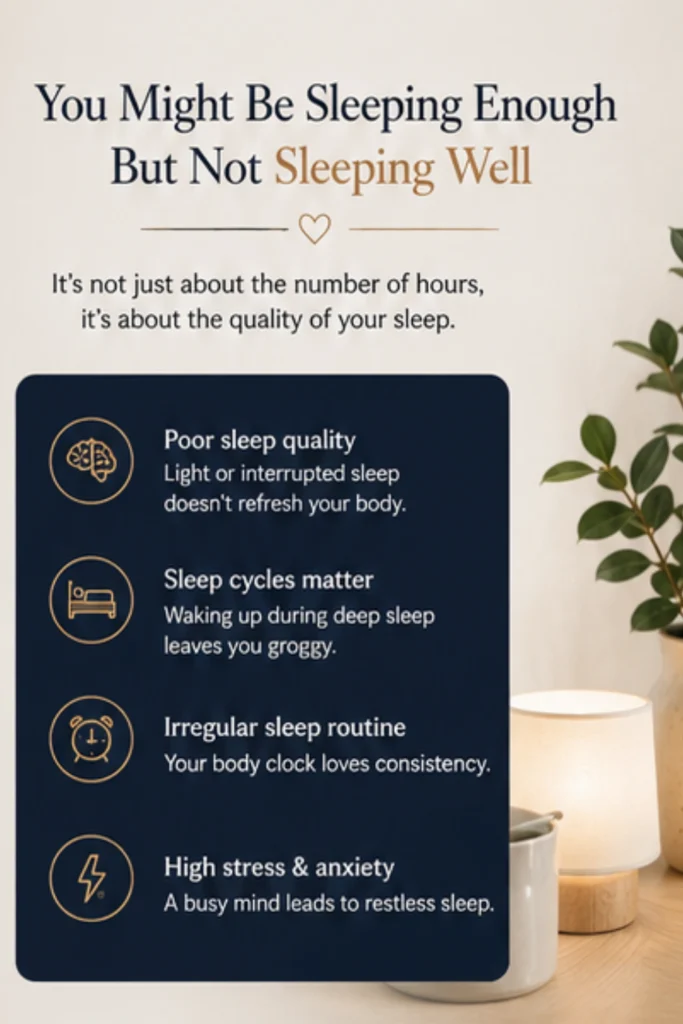
Sleep Duration Isn’t the Same as Sleep Quality
For years, most of us have been taught that eight hours of sleep is the gold standard. And while sleep duration matters, researchers now know that what happens during those hours matters just as much.
Every night, your brain moves through a series of carefully organized sleep stages:
If you’re wondering how much deep sleep your body actually needs at different stages of life, you can read our detailed guide on How Much Deep Sleep Do Adults Really Need by Age.
- Light sleep, where your body begins to relax.
- REM sleep, where your brain processes emotions, memories, and learning.
These stages repeat in cycles throughout the night.
The National Heart, Lung, and Blood Institute (NHLBI) explains that uninterrupted progression through these cycles is essential for waking up refreshed. If those cycles are repeatedly disrupted, even briefly, your body may never get enough of the deep, restorative sleep it needs.
That means you can spend eight hours in bed and still wake up feeling like you’ve been hit by a truck.
And often, the interruptions are subtle enough that you don’t even remember them.
A noisy street. A room that’s too warm. A buzzing phone. A partner who snores. Even small disturbances can fragment sleep without fully waking you up.
Your body may technically be asleep.
But your brain may never truly settle.
You Might Be Waking Up at the Wrong Time in Your Sleep Cycle
Have you ever slept for six hours and felt surprisingly okay, but after eight hours, you felt worse?
That’s not your imagination.
Sleep researchers call this sleep inertia, the groggy, heavy, mentally foggy feeling that happens when you wake up during deep sleep instead of during a lighter sleep stage.
According to experts at the Sleep Foundation, sleep inertia can affect alertness, memory, reaction time, and decision-making for anywhere from a few minutes to several hours.
This explains why some mornings feel harder than others, even when your bedtime was exactly the same.
Your alarm clock doesn’t know what stage of sleep you’re in.
It only knows what time it is.
So if your alarm pulls you out of deep sleep, your brain may need extra time to fully “boot up.”
That sluggish feeling, the urge to hit snooze, the inability to form complete thoughts before coffee, it’s not laziness.
It’s biology.
What helps?
Simple morning habits can reduce sleep inertia:
- Exposure to natural sunlight soon after waking
- Light movement or stretching
- Drinking water early
- Avoiding multiple snooze cycles
- Waking at the same time every day
These small cues tell your brain that it’s time to switch into daytime mode.
If you want to improve your deep sleep quality naturally, these science-backed habits can help. Read our guide on How to Increase Deep Sleep Naturally: 15 Science-Backed Strategies.
Your Body Clock May Be Working Against You
Sleep isn’t controlled by bedtime alone.
Your body follows a built-in 24-hour rhythm called the circadian rhythm, an internal clock that tells your body when to feel awake, alert, sleepy, hungry, and hormonally active.
Researchers at the National Institutes of Health (NIH) describe the circadian rhythm as one of the most important regulators of human sleep.
And when it gets disrupted, even a full night of sleep can feel unrefreshing.
Modern life is full of circadian disruptors:
- Late-night scrolling.
- Weekend sleep-ins.
- Working night shifts.
Binge-watching “just one more episode.”
Bright screens after sunset.
Sleeping until noon on Sundays and waking at 6 AM on Monday.
This pattern, often called social jet lag, confuses your internal clock.
And when your circadian rhythm is out of sync, your body may struggle to produce melatonin at the right time, regulate cortisol in the morning, or transition smoothly between sleep and wakefulness.
The result?
You wake up feeling tired, even after sleeping long enough.
What helps?
Resetting your circadian rhythm often starts with consistency:
- Wake up at the same time daily
- Get morning sunlight within the first 30 minutes
- Dim lights in the evening
- Limit blue-light exposure before bed
- Avoid dramatically different weekend schedules
- Your body loves rhythm.
- And sleep often improves when your schedule becomes predictable.
Hidden Breathing Problems Could Be Interrupting Your Sleep
One of the most overlooked reasons people wake up exhausted is poor breathing during sleep.
And often, they have no idea it’s happening.
Sleep apnea is a condition where breathing repeatedly stops and starts throughout the night. Each pause may last only a few seconds, but it can happen dozens or even hundreds of times.
Every time it happens, your brain partially wakes up to restart breathing.
You may never remember these awakenings.
But your nervous system does.
According to the Mayo Clinic, sleep apnea commonly causes:
- Loud snoring
- Morning headaches
- Dry mouth
- Gasping during sleep
- Daytime sleepiness
- Trouble concentrating
Many people assume sleep apnea only affects older adults or people who are overweight.
That’s not always true.
It can affect men, women, younger adults, and even people who appear healthy.
If you consistently wake up exhausted despite sleeping enough, and especially if someone has told you that you snore, this deserves attention.
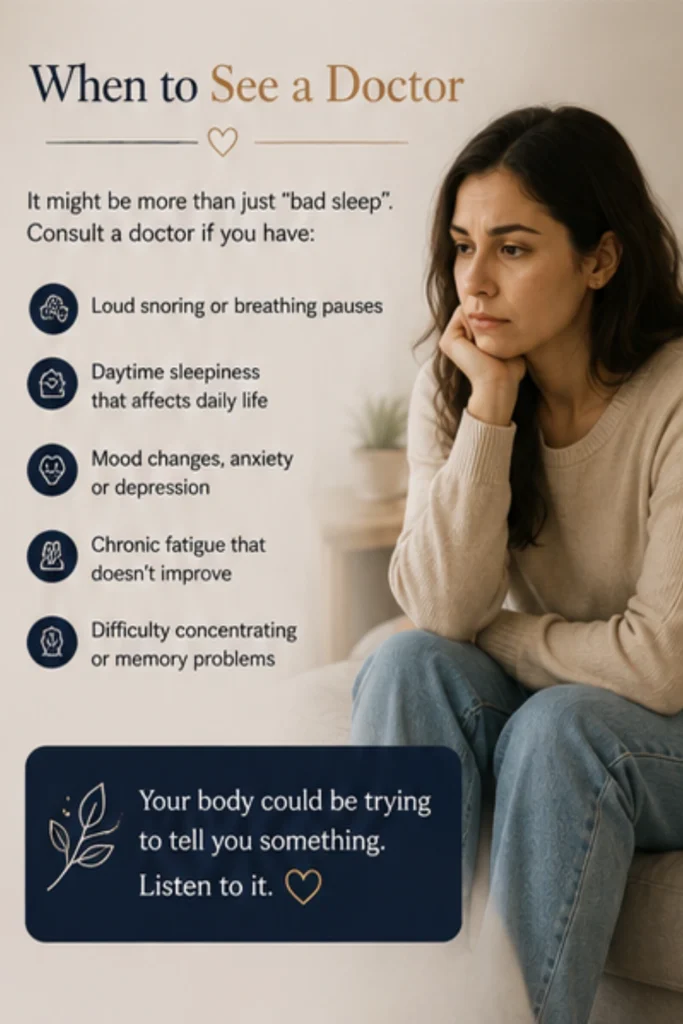
When to talk to a doctor:
If you experience:
- Loud snoring
- Choking or gasping during sleep
- Morning headaches
- Falling asleep during the day
- Unexplained brain fog
A professional sleep evaluation may reveal more than you expect.
Stress May Be Sleeping Beside You
You may be physically asleep.
But mentally?
Your brain might still be on duty.
Chronic stress affects sleep in ways many people underestimate.
When you’re under pressure, whether from work, finances, relationships, parenting, or health concerns, your body produces more cortisol, often called the stress hormone.
Normally, cortisol should be low at night and rise naturally in the morning.
But chronic stress can interfere with that rhythm.
Experts at Harvard Medical School’s Harvard Health Publishing note that elevated stress can reduce deep sleep, increase nighttime awakenings, and make sleep feel lighter and less restorative.
That means you may technically sleep eight hours.
But your nervous system never fully powers down.
Signs stress may be affecting your sleep include:
- Racing thoughts at bedtime
- Waking between 2–4 AM
- Vivid or emotionally intense dreams
- Jaw clenching or teeth grinding
- Waking up tense or anxious
What helps?
Instead of trying to “force” sleep, focus on calming your nervous system before bed:
- Journaling
- Breathwork
- Gentle stretching
- Meditation
- Reading something relaxing
- Avoiding work emails late at night
Even ten intentional minutes can make a difference.
Your Daily Habits May Be Quietly Sabotaging Your Sleep
Sometimes the real cause of morning fatigue starts long before bedtime.
What you do during the day shapes what happens at night.
Caffeine
That afternoon coffee may still be in your system at bedtime.
Sleep researchers have found that caffeine can affect deep sleep hours after you stop feeling its stimulating effects.
Alcohol
A drink may make you feel sleepy at first.
But alcohol often disrupts REM sleep later in the night, leading to fragmented sleep and early awakenings.
Physical inactivity
Regular movement helps regulate sleep pressure and circadian rhythms.
Sedentary lifestyles can make sleep lighter and less restorative.
Late heavy meals
Digestive activity close to bedtime can interfere with deep sleep and body temperature regulation.
What helps?
- Limit caffeine later in the day
- Avoid alcohol close to bedtime
- Move your body regularly
- Finish large meals several hours before sleep
- Create a calming evening routine
- Sleep doesn’t begin when your head hits the pillow.
It begins with how you live your day.
Sometimes the Real Problem Isn’t Sleep at All
This is an important truth many people overlook.
Sometimes you’re not tired because you slept poorly.
You’re tired because your body is asking for help.
Persistent fatigue can sometimes be linked to underlying health conditions such as:
- Iron deficiency
- Vitamin B12 deficiency
- Thyroid imbalance
- Blood sugar issues
- Anxiety or depression
- Chronic inflammation
- Medication side effects
The Centers for Disease Control and Prevention (CDC) recommends speaking with a healthcare professional if persistent fatigue continues despite healthy sleep habits.
Because sometimes the issue isn’t in your bedroom.
It’s in your biology.

So, Why Are You Sleeping Enough But Still Waking Up Tired?
Because sleep is never just about hours.
- It’s about rhythm.
- Breathing.
- Recovery.
- Hormones.
- Stress.
- Lifestyle.
- Environment.
And the countless invisible processes your body manages while you sleep.
The truth is, waking up tired isn’t something you should simply “push through.”
If you want a complete science-based overview of sleep cycles, deep sleep, circadian rhythm, and practical sleep improvement methods, read our full guide: The Complete Guide to Better Sleep: Science-Backed Strategies for Deep, Restorative Rest in 2026.
It’s information.
Your body is communicating.
And when you start listening, whether that means improving your sleep habits, managing stress, adjusting your schedule, or seeking medical guidance, you often discover that feeling energized in the morning isn’t luck.
It’s the result of understanding what your body has been trying to tell you all along.
Because real sleep doesn’t just help you survive the next day.
It helps you actually live it.