
We all know sleep matters. Yet when most people think about good sleep, they usually focus on one number: How many hours did I sleep last night? While sleep duration is important, sleep experts have spent decades reminding us that the real story goes much deeper. If you want to understand how sleep cycles, circadian rhythm, and sleep quality work together, explore our full guide: The Complete Guide to Better Sleep: Science-Backed Strategies for Deep Restorative Rest in 2026. What truly determines whether you wake up refreshed, mentally sharp, and physically recovered is not just how long you sleep, but how well your body moves through the different stages of sleep.
Among those stages, deep sleep stands out as one of the most important. It is the phase where the body repairs muscle tissue, supports immune function, regulates hormones, processes memories, and performs much of the internal recovery work that keeps us healthy. It is also the sleep stage that naturally changes as we get older.
That raises an important question for adults who track their sleep, struggle with fatigue, or simply want to age well:
How much deep sleep do adults actually need, and how does that number change with age?
The answer is not as simple as one universal number. Deep sleep requirements vary from person to person, but decades of sleep research show clear age-related patterns. What is considered normal for someone in their twenties is very different from what is typical in their sixties or beyond.
Understanding those changes can help you set realistic expectations, recognize potential sleep issues early, and make choices that support better long-term health.
Understanding Deep Sleep:
To understand why deep sleep matters, it helps to first understand how sleep works.
Sleep is not a single state. Throughout the night, your brain cycles through multiple sleep stages, including light sleep, deep sleep, and REM sleep. These stages repeat in cycles that typically last about 90 minutes.
Deep sleep, also known in sleep medicine as slow-wave sleep or stage N3 sleep, is the most physically restorative stage of non-REM sleep. During this phase, brain activity slows dramatically, heart rate decreases, breathing becomes more regular, and the body shifts into repair mode.
Researchers studying sleep physiology have found that several critical processes happen during deep sleep:
- Tissue repair and cellular recovery
- Muscle growth and physical restoration
- Release of growth hormone
- Strengthening of the immune system
- Memory consolidation
- Removal of metabolic waste from the brain
This is one reason why poor-quality sleep often leaves people feeling physically tired, mentally foggy, and emotionally drained, even after spending enough time in bed. If this happens frequently, you may want to explore the common causes explained in our guide: Why Am I Getting Enough Sleep but Still Waking Up Tired?
Deep sleep is not simply “nice to have.” It is a biological necessity.
How Much Deep Sleep Is Considered Normal?
Sleep researchers generally agree that healthy adults spend roughly 10 to 20 percent of total sleep time in deep sleep.
For someone sleeping seven to nine hours a night, that usually translates to approximately:
- 40 to 60 minutes at the lower end
- 90 to 120 minutes at the higher end
However, this range changes significantly with age.
One of the biggest misconceptions people have, especially those who use sleep trackers, is assuming there is a perfect target number for everyone. In reality, age, genetics, lifestyle, stress levels, activity levels, and overall health all influence how much deep sleep your body produces.
The key is understanding what is normal for your stage of life.
Deep Sleep by Age:
Ages 18 to 25: The Peak Years
Young adulthood is when deep sleep tends to be at its highest.
People in their late teens and early twenties often spend 20 to 25 percent of total sleep in deep sleep, which typically equals:
- 90 to 120 minutes per night
There are good biological reasons for this.
Although physical growth slows after adolescence, the brain continues developing well into the mid-twenties, particularly areas involved in decision-making, emotional regulation, and long-term planning.
At the same time, young adults often have higher physical recovery demands, stronger hormone production, and more robust nervous system activity.
Deep sleep during this stage supports:
- Learning and academic performance
- Athletic recovery
- Muscle repair
- Hormonal balance
- Emotional resilience
This is also why younger adults often bounce back faster after intense workouts, late nights, or mentally demanding days.
Ages 26 to 39: Early Adulthood
By the late twenties and thirties, deep sleep usually begins a gradual decline.
Typical deep sleep during this stage often falls between:
- 70 to 100 minutes per night
This decline is completely normal.
What makes this age range challenging is that lifestyle often starts affecting sleep more than biology alone.
Career pressure, raising children, financial responsibilities, irregular schedules, frequent travel, late-night screen exposure, caffeine, and alcohol can all interfere with deep sleep.
Interestingly, many adults in their thirties still get enough total sleep but begin waking up feeling less refreshed than they did in their twenties.
In many cases, the issue is not sleep duration. It is reduced deep sleep quality.
Ages 40 to 59: Midlife Changes
By midlife, changes in sleep architecture become more noticeable.
Most adults in this age group average:
- 45 to 90 minutes of deep sleep
For many people, this is when they first notice that sleep feels lighter, interruptions become more common, and recovery takes longer.
Hormones play a major role.
For women, perimenopause and menopause can affect body temperature regulation, stress response, and nighttime comfort.
For men, gradual testosterone decline may influence sleep depth and muscle recovery.
At the same time, health conditions that become more common in midlife can disrupt deep sleep, including:
- Weight gain
- Insulin resistance
- High blood pressure
- Mild sleep apnea
- Chronic inflammation
- Joint discomfort
Stress also tends to peak during these years, and elevated cortisol can interfere with the brain’s ability to enter deeper sleep stages.
Ages 60 to 75: Sleep Becomes Lighter
By the sixties and seventies, deep sleep often becomes noticeably shorter.
Most healthy adults in this age group average:
- 30 to 60 minutes of deep sleep per night
This change is largely driven by natural aging in the brain.
As we age:
- Melatonin production decreases
- Growth hormone release declines
- Circadian rhythms shift earlier
- Delta brain wave activity weakens
As a result, older adults often:
- Fall asleep earlier
- Wake earlier
- Experience lighter sleep
- Wake more often during the night
These changes are normal, but quality still matters.
Even though deep sleep decreases, the body continues depending on restorative sleep for immune health, memory, metabolic regulation, and tissue recovery.
Age 75 and Beyond
After age 75, deep sleep may become quite limited.
Typical ranges often fall between:
- 20 to 45 minutes per night
This does not automatically signal poor sleep or poor health.
Sleep scientists have found that the aging brain naturally produces fewer slow-wave sleep patterns.
Many healthy older adults function well with lower deep sleep numbers than younger adults.
What matters most at this stage is daytime function.
If an older adult wakes feeling reasonably refreshed, stays mentally alert, and maintains daily energy, lower deep sleep is often completely normal.
Why Deep Sleep Naturally Declines With Age:
Sleep researchers point to several biological changes that explain why deep sleep decreases over time.
Changes in Brain Activity
As the brain ages, it produces fewer strong delta waves, which are essential for deep sleep.
Hormonal Shifts
Growth hormone, estrogen, progesterone, and testosterone all influence sleep architecture. As these hormones change, sleep depth often changes too.
Increased Medical Conditions
Conditions such as Type 2 Diabetes, Hypertension, and Sleep Apnea can interrupt deep sleep.
Medication Effects
Many common medications may alter sleep stages, especially medications affecting the nervous system or cardiovascular system.
Stress and Modern Lifestyle
Chronic stress keeps cortisol elevated, which can make it harder for the brain to transition into deeper restorative sleep.

Can Sleep Trackers Be Trusted?
Wearable technology has made sleep tracking more popular than ever.
Devices from companies such as Apple Inc., Garmin Ltd., and Fitbit can estimate deep sleep based on movement, heart rate, temperature, and breathing patterns.
These devices can be useful for spotting trends.
However, sleep specialists caution against obsessing over nightly scores.
Professional sleep studies still remain the most accurate way to measure sleep stages.
Your energy levels, focus, recovery, and mood often tell a more meaningful story than your app.
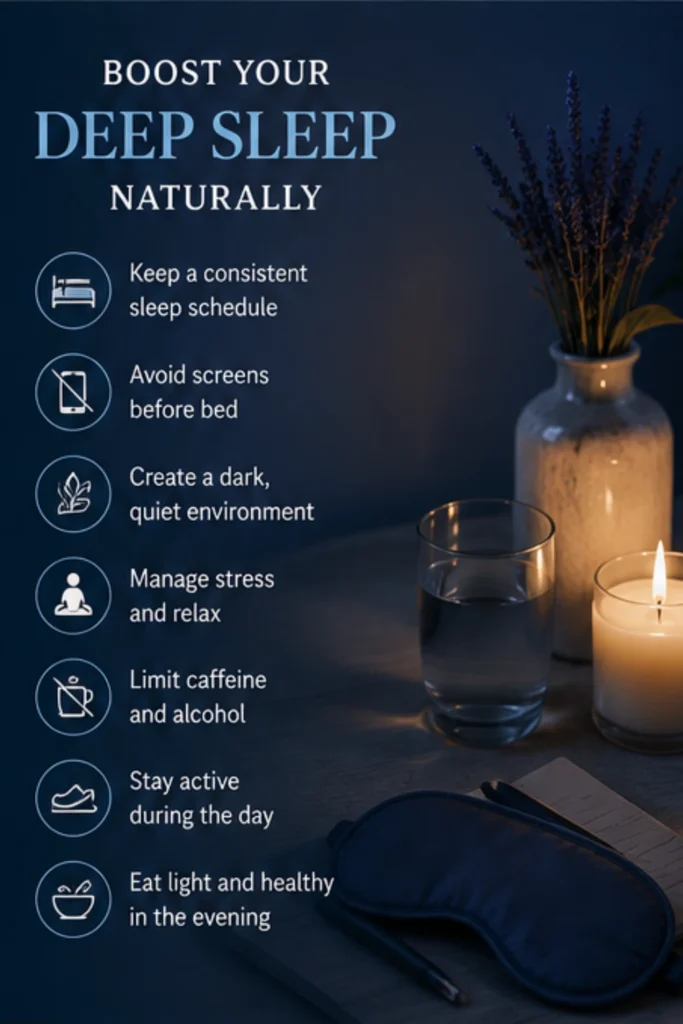
How to Support Deep Sleep Naturally:
The encouraging news is that while aging changes deep sleep, lifestyle still matters.
Research consistently shows that these habits support healthier deep sleep:
If you want practical ways to improve your sleep quality, you can also read our detailed guide: How to Increase Deep Sleep Naturally: 15 Science-Backed Tips for Better Rest.
Move Your Body Daily
Regular exercise improves sleep efficiency and increases slow-wave sleep.
Keep a Consistent Schedule
Sleeping and waking at the same time helps regulate circadian rhythms.
Limit Alcohol Before Bed
Alcohol may help you fall asleep faster, but it often reduces deep sleep later in the night.
Reduce Evening Caffeine
Caffeine can stay active for hours and delay deeper sleep stages.
Keep Your Bedroom Cool and Dark
A cooler sleep environment supports deeper physiological recovery.
Manage Stress
Meditation, breathwork, reading, and evening routines can lower cortisol and improve sleep depth.
Final Thoughts:
So, how much deep sleep do adults really need?
The answer changes throughout life:
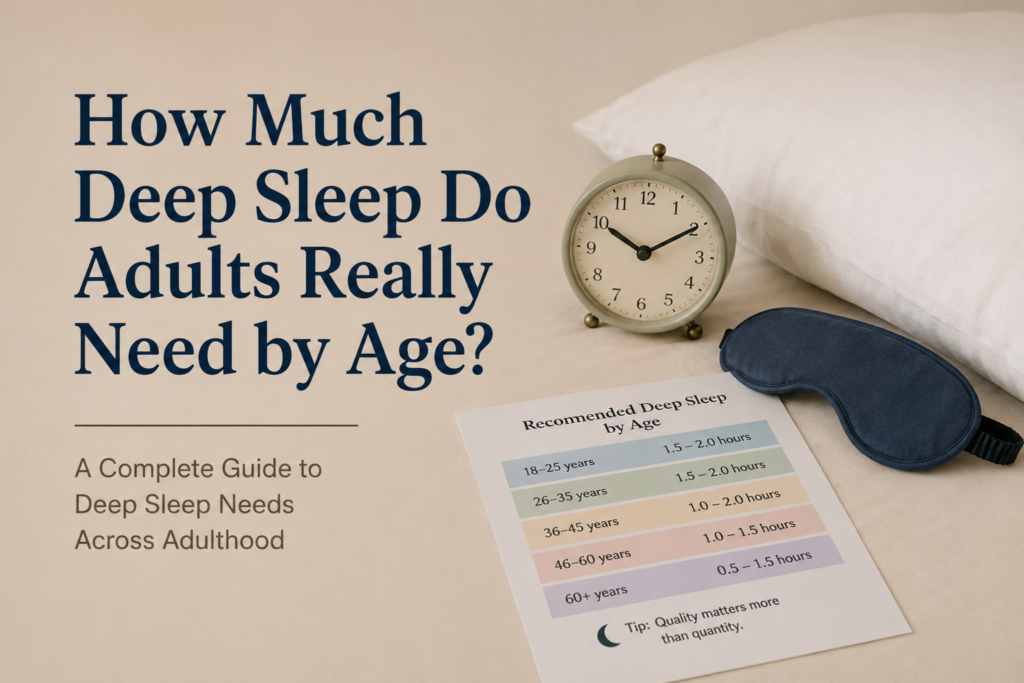
Age
Typical Deep Sleep
- 18–25
90–120 minutes
- 26–39
70–100 minutes
- 40–59
45–90 minutes
- 60–75
30–60 minutes
- 75+
20–45 minutes
Deep sleep naturally decreases with age. That is normal.
What matters most is not chasing a perfect number.
What matters is waking up feeling restored, thinking clearly, recovering well, and maintaining long-term health.
Because when it comes to sleep, quality often matters far more than quantity.