
Have you ever had one of those moments when something inside you quietly says, “Don’t do this,” or “This feels right,” even when you can’t explain why?
Maybe you were about to accept a job, enter a relationship, make a big move, or say yes to an opportunity, and something deep inside either pulled you closer or asked you to pause. Later, you realized that inner feeling was trying to tell you something important.
Most of us have experienced this.
The challenge is that our inner world is not always easy to understand. Sometimes what feels like intuition is actually fear. Many people experience these inner conflicts during periods of personal growth and life transitions. Sometimes fear disguises itself as logic. And sometimes genuine inner wisdom gets buried beneath overthinking, anxiety, past experiences, and the opinions of other people.
So how do you know the difference?
How do you recognize your inner voice when fear is speaking just as loudly?
Learning to tell intuition apart from fear is one of the most powerful forms of self-awareness. It can shape your relationships, career choices, boundaries, personal growth, and overall well-being. More importantly, it can help you build something many people spend years searching for: trust in yourself.
What Is Intuition, Really?
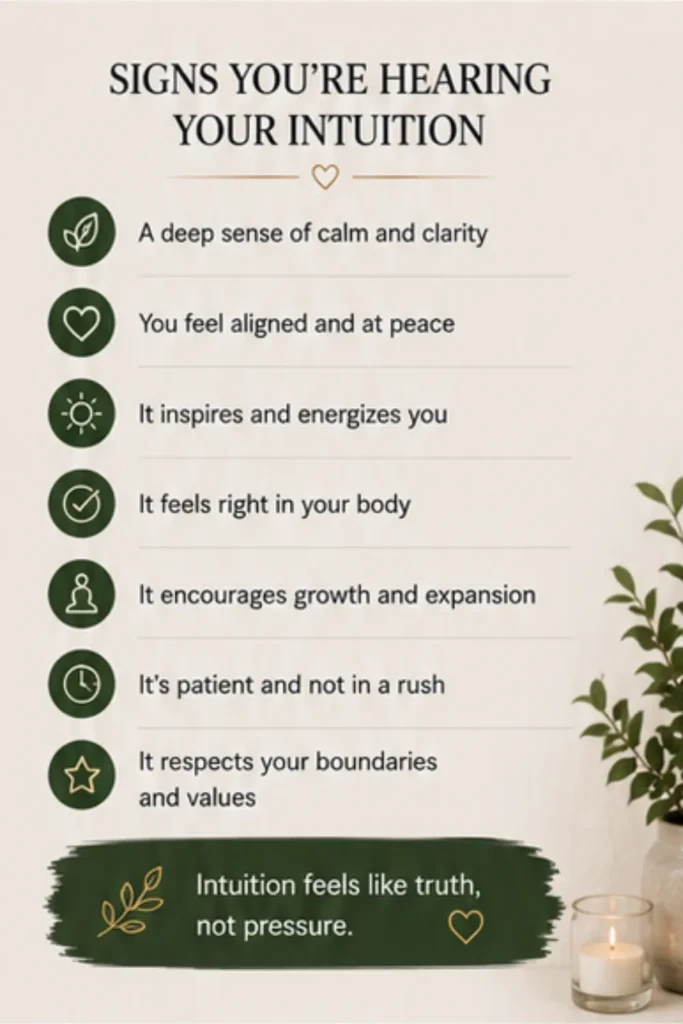
People often describe intuition as a gut feeling, an inner knowing, or a quiet sense that something is right or wrong before the mind catches up.
It is that feeling you get when you meet someone for the first time and instantly sense whether you feel comfortable around them.
It is the unexplained pull toward a certain path. Similar experiences often appear when people begin noticing subtle signs and synchronicities in life.
It is the quiet nudge that tells you to wait, to move, to speak up, or sometimes to walk away.
Intuition does not usually arrive with a long explanation. It does not debate, argue, or try to convince you.
It simply knows.
That is why many people miss it. We are used to listening to the loudest voice in our minds, and intuition is rarely loud.
It is subtle.
It is calm.
And often, it speaks in the spaces between thoughts.
What Fear Feels Like
Fear is different.
Fear is designed to protect you. It is part of being human. Without fear, we would not recognize danger, avoid harmful situations, or learn from painful experiences.
Fear itself is not the problem.
The problem begins when fear starts treating every unfamiliar experience as a threat.
A new job feels risky.
A new relationship feels unsafe.
Speaking your truth feels dangerous.
Setting boundaries feels uncomfortable.
Trying something bigger feels terrifying.
Fear does not always scream “Danger.” Sometimes it sounds much more reasonable.
It says things like:
- “Maybe later.”
- “You’re not ready yet.”
- “What if this goes wrong?”
- “What if people judge you?”
- “What if you fail?”
And before you know it, fear can start sounding like wisdom.
That is where confusion begins.
The Biggest Difference Between Intuition and Fear
If there is one simple way to tell them apart, it is this:
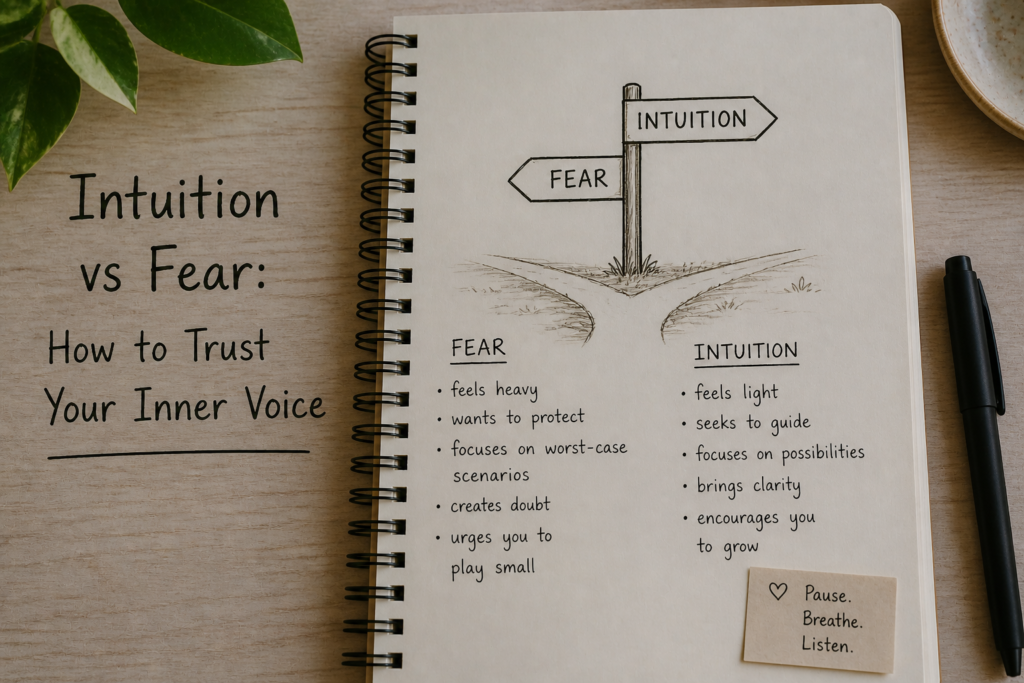
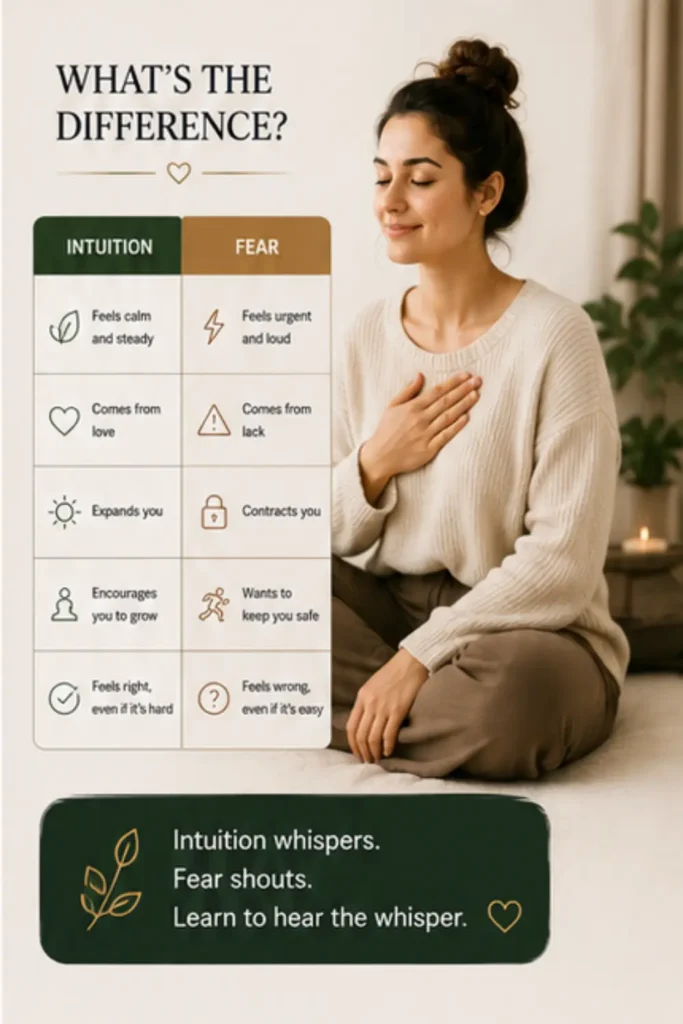
- Intuition feels clear. Fear feels noisy.
- Intuition may tell you something difficult, but it usually comes with a strange sense of peace.
- Fear, on the other hand, often comes with tension.
- It creates mental loops.
- It makes you replay conversations.
- It pushes you to imagine worst-case scenarios.
It fills your mind with “what if” questions.
Intuition might say:
“This relationship is not right for you.”
Fear says:
“What if you leave and never find anyone better?”
Intuition says:
“Take the opportunity.”
Fear says:
“What if you embarrass yourself?”
Intuition gives direction.
Fear creates distraction.
Your Body Often Knows Before Your Mind
One of the easiest ways to tell whether you are experiencing intuition or fear is to pay attention to your body.
Your body is constantly giving you information, even when your mind is busy overthinking.
When intuition is present, many people notice feelings like:
- A sense of calm
- A deep breath
- An open chest
- A grounded feeling
- Quiet certainty
Even if the decision feels challenging, there is often a sense of inner alignment.
Fear usually feels different.
You may notice:
- Tightness in your chest
- Shallow breathing
- A racing heart
- Restlessness
- Tension in your shoulders or jaw
- A knotted feeling in your stomach
Your mind may be saying one thing, but your body often reveals the truth.
Learning to listen to your body is one of the most powerful ways to reconnect with your inner wisdom.
Why Fear Often Sounds So Convincing
Fear usually has history behind it.
It is often connected to old experiences.
Maybe you trusted someone before and got hurt.
Maybe you took a risk once and failed.
Maybe you were judged, rejected, criticized, or made to doubt yourself.
Your mind remembers those moments.
And because the brain is designed to protect you, it may try to keep you from experiencing similar pain again.
So when a new opportunity appears, fear does not always see possibility.
It sees potential danger.
That is why fear often sounds intelligent.
It brings evidence.
It reminds you of past mistakes.
It builds convincing arguments.
But just because fear sounds logical does not mean it is telling the truth.
Sometimes fear is simply trying to keep you in what feels familiar.
And familiar is not always the same as healthy.
Intuition Does Not Rush You
This is something many people overlook.
Fear is urgent.
Fear wants answers right now.
Fear says:
- “Decide immediately.”
- “Do something.”
- “Fix this.”
- “Run.”
Intuition rarely behaves that way.
Intuition is patient.
It does not force.
It does not panic.
Even when it asks you to act, there is usually clarity instead of chaos.
If your inner voice feels frantic, overwhelming, or desperate, fear may be leading the conversation.
If it feels quiet, steady, and consistent, intuition may be speaking.
Why Modern Life Makes It Hard to Hear Yourself
The truth is, many people are not disconnected from their intuition because they lack it.
They are disconnected because life is noisy.
From the moment we wake up, we are surrounded by:
- Notifications
- Social media
- News updates
- Emails
- Opinions
- Comparisons
- Pressure to perform
When your mind is constantly consuming external information, it becomes harder to hear internal guidance.
That quiet inner voice gets buried.
And when that happens, fear often takes over because fear is louder.
This is why slowing down matters.
Recovery, rest, and mindful routines can help create the mental space needed to reconnect with yourself.
Not as a luxury.
As a necessity.
How to Strengthen Your Intuition
The good news is that intuition is not something you either have or do not have.
It is something you can strengthen.
Like any relationship, trust grows through attention.
Here are a few simple ways to reconnect with your inner voice.
- Spend Time in Silence
Silence creates space.
Even ten minutes without your phone, music, television, or conversation can help you notice what has been trying to surface.
Sit quietly.
Take a walk.
Breathe.
Listen.
At first, your mind may feel busy.
That is normal.
Keep showing up.
Even simple low-pressure movement like walking can improve clarity and reduce mental overwhelm.
- Stop Asking Everyone Else First
Many people instinctively ask friends, family, partners, or social media for advice before asking themselves what they actually feel.
External guidance can be helpful.
But if everyone else’s voice comes before your own, self-trust becomes difficult.
Before asking others, ask yourself:
“What do I honestly want?”
That question can be surprisingly powerful.
- Write Without Editing
Journaling can reveal thoughts and feelings you may not notice during the day.
Try writing answers to questions like:
- What feels true right now?
- What am I afraid of?
- What decision feels peaceful?
- If I trusted myself completely, what would I do?
Do not overthink the answers.
Just write.
Often, your truth appears when your mind stops trying to sound perfect.
- Notice Patterns
Think about times in your life when you ignored your gut feeling.
What happened?
Now think about times when you trusted yourself.
What happened then?
Patterns teach.
Your past can show you how your intuition speaks.
- Heal What Fear Is Protecting
Sometimes fear is loud because there are wounds that still need attention.
Past rejection.
Past heartbreak.
Past failure.
Past criticism.
Healing those experiences can make your inner voice much easier to hear.
Sometimes self-trust is not about finding intuition.
Sometimes it is about removing what is drowning it out.
When Fear Is Actually Helpful
Not all fear is false.
Sometimes fear is wisdom.
If something genuinely feels unsafe, manipulative, harmful, or dangerous, fear may be doing exactly what it was designed to do.
The goal is not to silence fear completely.
The goal is to understand it.
To know when fear is protecting you.
And to know when fear is simply protecting your comfort zone.
Those are two very different things.
Trust Is Built in Small Moments
Many people think trusting your intuition means making huge life-changing decisions.
Sometimes it does.
But more often, self-trust is built in small everyday moments.
Saying no when you mean no.
Speaking up when something feels wrong.
Resting when your body feels exhausted.
Walking away when something no longer feels aligned.
Choosing what feels true, even when it is uncomfortable.
Every small act of listening strengthens your relationship with yourself.
And over time, that relationship becomes unshakable.
Conclusion:
Learning the difference between intuition and fear is not about becoming fearless.
It is about becoming honest.
Fear will always have a voice.
That is part of being human.
But fear does not have to make every decision.
Somewhere beneath the noise, beneath the doubt, beneath the overthinking, there is a quieter voice.
A calmer voice.
A wiser voice.
Your voice.
And the more you listen to it, the easier it becomes to recognize what has been true all along.
You already carry the wisdom you are searching for.
The real journey is learning to trust it.
About K. K. Masetu
K. K. Masetu is the founder of How To Be Healthy N Fit. He is passionate about holistic well-being, mindful living, personal growth, and healthy lifestyle practices. Through his writing, he shares practical insights and inspiring ideas to help readers nurture their physical, mental, emotional, and spiritual well-being.